Free printable template
Free toolbox talk template and sign-in sheet
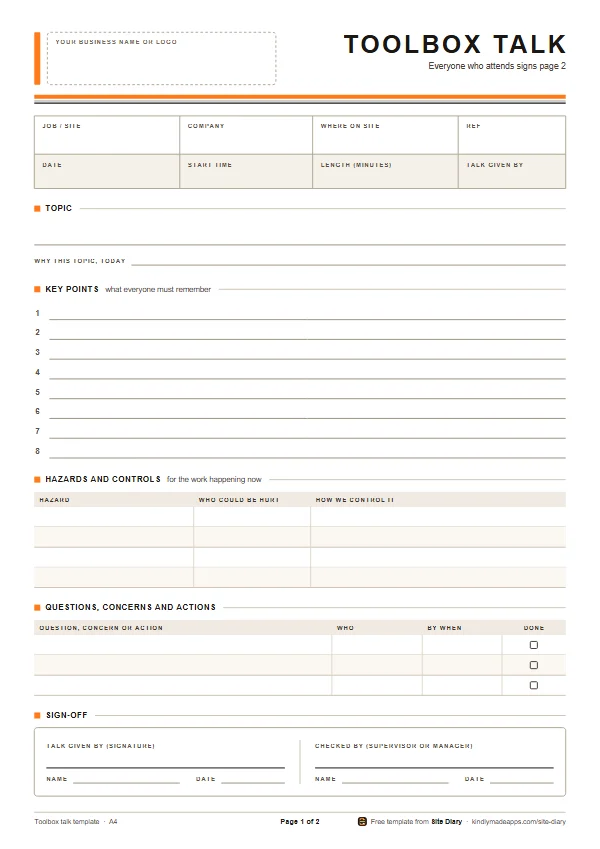
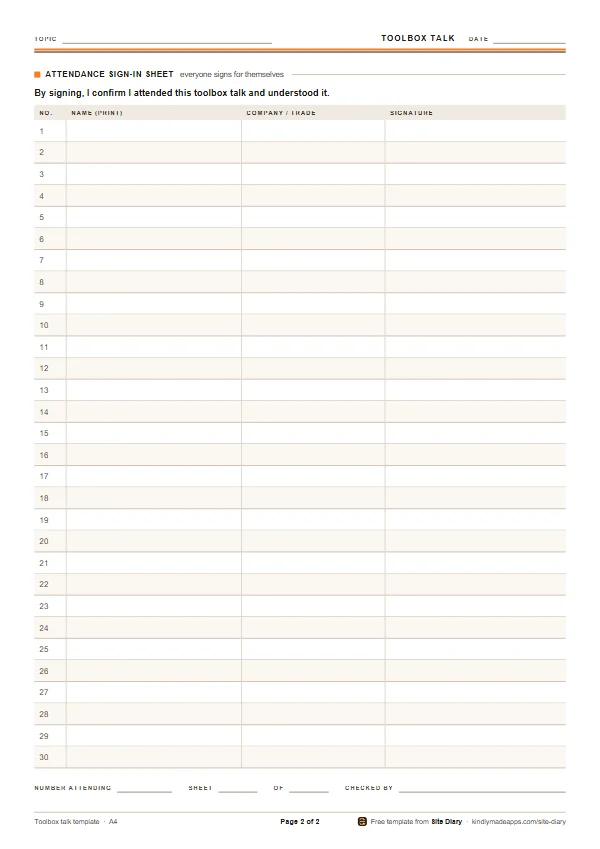
A two-page toolbox talk form: the topic, key points, hazards and controls, and questions and actions on page 1, and an attendance sign-in sheet on page 2, with room for 30 people on A4 and 28 on US Letter.
For every region. Toolbox talks go by the same name in the UK, Ireland, Australia, New Zealand, South Africa, the US and Canada.
Last updated
What’s on it
The talk on one page, the signatures on the other
Print a stack, keep it in the site box, and fill one in each time you give a talk. Everyone who attends signs page 2.
Page 1: the talk
- A box for your business name or logo
- Job or site, company, where on site and a reference
- Date, start time, length, and who gave the talk
- The topic, and why it matters today
- Numbered key points
- Hazards and controls: the hazard, who could be hurt, and how it is controlled
- Questions, concerns and actions, with who and by when
- Sign-off by the presenter and a supervisor or manager
Page 2: the sign-in sheet
- “By signing, I confirm I attended this toolbox talk and understood it.”
- Numbered rows for each person’s printed name, company or trade, and signature
- The number attending, the sheet number, and who checked it
- The topic and date at the top, so a loose sheet can be matched to its talk
What a toolbox talk is, and why it matters
The UK’s Health and Safety Executive describes a toolbox talk as “a short presentation to the workforce on a single aspect of health and safety”. On most sites it lasts 5 to 15 minutes, often at the start of a shift, and it is about the work that is actually happening: today’s hazards, how to stay safe, and what to do if something goes wrong.
- It puts today’s hazards in front of the people about to face them, while they can still do something about them.
- It is a record. A signed sheet shows who was told what, and when, if there is ever an incident, an inspection or a claim.
- It is often expected. Main contractors and clients often ask for toolbox talk records, and safety laws expect employers to inform, instruct and involve their workers (see the notes for your region below).
- It is a chance to listen. The people doing the work often spot a hazard first. A good talk ends with questions, and the answers become actions.
What to record on the form
- Job, company and place
- The job or site, your company, where on site the talk was given, and a reference if you number your talks.
- Date, time, length and presenter
- When it started, how many minutes it took, and who gave it.
- Topic, and why today
- One topic per talk. Say why it matters now, such as “roofers start on the rear slope today” or “first frost forecast this week”.
- Key points
- Three to six short points everyone must remember. If you can’t fit them on the lines, the talk is too long.
- Hazards and controls
- Each hazard, who could be hurt, and how it is controlled on this site, for example “open edge on the first floor, everyone working up there, edge protection in place before work starts”.
- Questions, concerns and actions
- Anything raised, who will deal with it and by when. Tick each one off when it is done.
- Sign-off
- The presenter signs and dates the talk, and a supervisor or manager checks it.
- Sign-in sheet
- Each person prints their name and company or trade, and signs for themselves. Write the number attending at the bottom, and use a second sheet for a bigger crew.
How to give a good toolbox talk
- Keep it short and on one topic. Ten good minutes beat half an hour nobody remembers.
- Make it about today’s work on this site, not a hazard from somebody else’s job.
- Show, don’t just read. Hold up the harness, point at the edge, open the first aid kit.
- Ask questions and let people answer. “What would you do if…” gets more attention than a lecture.
- Use plain words, and check everyone understood, including anyone whose first language isn’t English.
- Write down the actions and follow them up, then tell the crew what was done at the next talk.
- Everyone signs for themselves, subcontractors included. Give late arrivals the talk before they sign.
A sample talk: ladders
Here is how a short talk might look on the form. Topic: working from ladders. Why today: the plasterers start on the stairwell ceiling.
Key points, based on the UK Health and Safety Executive’s ladder guidance:
- Check the ladder before you use it: the feet, rungs, stiles and any locking bars.
- Ladders are for short, light jobs. For longer work, use a tower or a platform.
- Set a leaning ladder at the right angle, one out for every four up, on firm, level ground.
- Keep three points of contact, and don’t overreach: move the ladder instead.
- Don’t work off the top three rungs of a leaning ladder.
Hazards and controls: a fall from height, for anyone using the ladder, controlled by the checks, a footed or tied ladder and the right kind of access; dropped tools, for anyone below, controlled by keeping the area under the ladder clear.
Common mistakes
- Reading out a generic script that has nothing to do with the work on site.
- Talking for too long, with no time for questions.
- One person writing in everyone’s names.
- No follow-up, so the same problems come up week after week.
- The same topic every time.
- Losing the sheets. Photograph each signed sheet the same day and file it with the job.
Topic ideas
- Working at height and ladders
- Scaffolds and edge protection
- Manual handling
- Excavations and buried services
- Dust and silica
- Noise and vibration
- Working in heat and sun
- Working in cold and wet weather
- Slips, trips and housekeeping
- Plant and vehicle movements
- Electrical safety and temporary power
- Hand and power tools
- Personal protective equipment
- Fire and emergency procedures
- First aid and reporting incidents
- Asbestos awareness
- Fatigue and mental health
- Lifting operations
Notes for your region
Safety law differs from place to place, but every one of these regions expects employers to tell their workers about the risks of the work and how to stay safe.
- United KingdomUnder the CDM Regulations 2015, the principal contractor must make sure a suitable site induction is provided. HSE publishes free construction toolbox talks on topics such as ladders, roof work and manual handling.
- IrelandConstruction workers must hold a Safe Pass card, from a one-day safety awareness programme. It doesn’t replace an employer’s duty to give other health and safety training, which is where site-specific toolbox talks come in.
- AustraliaUnder the model WHS laws, a business must consult its workers on health and safety matters that affect them. Safe Work Australia says there is no general requirement to record consultation unless the regulations ask for it, but keeping records is good practice.
- New ZealandThe Health and Safety at Work Act 2015 requires a business to engage with its workers on health and safety, and to give them reasonable opportunities to take part in improving it.
- South AfricaUnder the Construction Regulations 2014, a contractor may not let anyone onto site without health and safety induction training on the site’s hazards, and must keep the induction records on site.
- United StatesOSHA requires employers to instruct each employee in recognizing and avoiding unsafe conditions (29 CFR 1926.21(b)(2)). Signed toolbox talk sheets are a common way to show it happened.
- CanadaWorkplace safety is regulated mostly by each province and territory, so check your provincial rules on training and safety meetings.
General guidance, not legal advice. Check your contract.
Paper or phone?
Keep each talk with the day’s record
Site Diary logs the day’s toolbox talk in the health and safety section of your site diary, so it sits with the labour, the work, the delays and the stamped photos from the same day:
- A full day’s record in about 60 seconds, on your phone.
- Photos stamped with the date, time and GPS position.
- Sign the day and it locks, then send it as a PDF in two taps.
- Keep the signed sign-in sheet with it: photograph the sheet into the same day.
Coming soon to Google Play
Free for your first 2 months, no card needed.

Toolbox talk questions
How long should a toolbox talk be?
Usually 5 to 15 minutes: long enough to cover one topic properly and take questions, and short enough that people keep listening.
How often should we hold toolbox talks?
Many sites hold one a week, and more often on high-risk work, or whenever the work, the crew or the hazards change. Your main contractor or client may set a minimum, so check what they expect.
Is a toolbox talk the same as a site induction?
No. A site induction is given to each person before they start work on a site, and covers that site’s rules, hazards and emergency arrangements. A toolbox talk is a short, regular talk on one topic for the people working there now.
Who should sign the toolbox talk sign-in sheet?
Everyone who attended, each person signing for themselves, including subcontractors. Never fill in names for people who weren’t there. Anyone who arrives late gets the talk before they sign.
How long should I keep toolbox talk records?
Keep them with the job’s safety records for at least as long as your company, client or main contractor requires, and for longer if anything happened on site that could lead to a claim or an investigation.
Where can I find toolbox talk topics?
Start with the work happening this week and the near misses you have had. For ready-made material, the UK’s Health and Safety Executive publishes free construction toolbox talks, and most national safety regulators publish free guidance on common hazards.