The breakpoint in bowling, and the rule of 31
Your breakpoint is where the ball stops heading out and turns back toward the pocket. Here’s how to read yours, and a rule of 31 calculator for where to aim it on any oil pattern.
Rule of 31 calculator
What is the breakpoint?
A hook ball doesn’t curve all the way down the lane. It skids through the oil on the front of the lane, then grips the drier boards beyond it and hooks toward the pocket. The breakpoint is the point between the two: the farthest the ball gets from the pocket before it turns back.
It has two parts: a board, counted from your bowling hand’s side, and a distance down the lane. A breakpoint on board 8 at 40 feet means the ball got out to the 8 board, 40 feet past the foul line, before it started back.
Why it matters
Your breakpoint decides where the ball can get to from there. If it’s too far out for the oil, the ball runs out of room to come back and misses the head pin to the outside; too far in, and it comes back too soon and crosses over to the other side. Lining up is mostly about finding the breakpoint that sends the ball into the pocket, and repeating it.
The rule of 31
Take the oil pattern’s length in feet, subtract 31, and that’s roughly the board to aim your breakpoint at, near the end of the oil.
| Pattern length | Breakpoint near |
|---|---|
| 33 feet | Board 2 |
| 35 feet | Board 4 |
| 38 feet | Board 7 |
| 40 feet | Board 9 |
| 41 feet | Board 10 |
| 42 feet | Board 11 |
| 44 feet | Board 13 |
| 45 feet | Board 14 |
| 47 feet | Board 16 |
It’s a starting point, not an answer. Your speed, your revs, your ball’s surface and how the oil has broken down all move the real breakpoint, so start where the rule says, watch what the ball does, and adjust.
How to find your breakpoint
- Watch from behind. Ask a friend to stand behind you, or watch the ball yourself after you release it. Note the board where it stops moving outward.
- Use the lane’s marks for distance. The arrows are between 12 and 16 feet past the foul line, and many lanes have range finders, the lines between about 33 and 44 feet. They help you judge how far down the ball turned.
- Film it. A video from behind, stepped through a frame at a time, shows the turn far better than your eyes do in the moment.
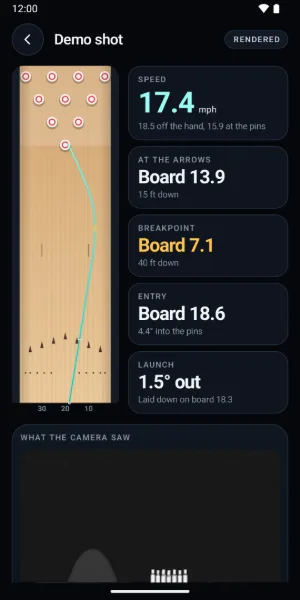
- Or let BowlSight measure it. BowlSight finds every shot’s breakpoint, its board and its distance, from a phone on a tripod behind you, and shows how much it varies over a session.
Moving your breakpoint
To send the ball to a different breakpoint, change where you stand and where you aim at the arrows. Moving your feet and your target the same way moves the breakpoint while keeping a similar angle; moving your feet more than your target opens the angle up. Small moves, a board or two at a time, are easier to read.
Questions about the breakpoint
What is a breakpoint in bowling?
The point where a hook ball stops heading out toward the gutter and turns back toward the pocket: the farthest it gets from the pocket. It’s given as a board, counted from your bowling hand’s side, and a distance down the lane.
What is the rule of 31?
A rule of thumb for where to aim your breakpoint: the oil pattern’s length in feet, minus 31, gives the board. On a 42-foot pattern that’s around the 11 board, near the end of the oil. It’s an approximation to start from, then adjust to what your ball does.
Where should my breakpoint be on a house shot?
House patterns are often around 38 to 42 feet long, so the rule of 31 points to roughly boards 7 to 11. Ask the centre how long theirs is, and use the calculator above.
Does the rule of 31 work on short patterns?
Less well. On patterns much shorter than about 33 feet it points into the gutter, and the ball reaches dry boards early anyway. Treat it as a guide for typical lengths.
How far down the lane should the breakpoint be?
Usually around the end of the oil, where the ball meets the drier boards and starts to hook. On a 42-foot pattern, that’s around 42 feet down the lane.
Or let BowlSight measure it
BowlSight is a bowling ball tracker for Android. With your phone on a tripod behind you, it measures every shot: the ball’s speed off your hand, on average and at the pins, the board at the arrows, the breakpoint and the entry angle. No sensor, no ads, and your videos stay on your phone.
Where these numbers come from
- The rule of 31: Human Kinetics, “Determining the breakpoint using the rule of 31”.
- The arrows (12 to 16 feet) and range finders (33 to 44 feet): USBC’s Equipment Specifications and Certifications Manual.