Bowling rev rate calculator
Work out your rev rate, the revolutions per minute your ball turns at as it leaves your hand, from a phone video: with USBC’s tape-and-clock method, or by counting turns.
The calculator
How to measure your rev rate on video
This is the method the United States Bowling Congress (USBC) describes. You need a phone that films video, a strip of tape and a few minutes.
- Find your ball’s axis, the point it spins around as it leaves your hand, and put a strip of tape from there to just above the finger holes.
- Film your release, close up, so the tape is easy to see. Note the video’s frame rate: 30 or 60 frames a second, or 120 or 240 for slow motion.
- Step through the video to the first frame after your fingers leave the ball.
- Step forward 10 frames and see how far the tape turned, counting like the hours on a clock: a quarter turn is 3 hours, half a turn 6, a full turn 12, a turn and a half 18.
- Enter that and the frame rate above. At 30 frames a second, the hours times 15 is your rev rate.
Rev rate (rpm) = hours in 10 frames × 15 × (frame rate ÷ 30)
A full turn is 12 hours, and 10 frames at 30 frames a second is a third of a second.
Counting turns over a stretch
You can also count whole turns of a mark on the ball over a longer stretch of frames: rev rate = turns × 60 × frame rate ÷ frames. Count from the moment the ball leaves your hand. Don’t count every turn all the way to the pins and call that a minute’s worth: the ball’s spin changes on its way down the lane, and that’s revolutions per shot, not per minute.
Is that a high rev rate?
Bowlers are often sorted into three rough groups by rev rate. The lines between them differ from source to source.
| Rev rate | Often called |
|---|---|
| Under about 300 rpm | Stroker |
| About 300 to 400 rpm | Tweener |
| Over about 400 rpm | Cranker |
Questions about rev rate
What is rev rate in bowling?
Rev rate is how fast your ball spins as it leaves your hand, in revolutions per minute (rpm). With your speed and your ball, it decides how much and how sharply the ball hooks.
What is a good rev rate?
No rev rate is good or bad on its own. What matters is a rev rate you can repeat, matched to your speed: more revs need more speed, or the ball hooks too early. USBC tests balls with an average bowler’s delivery of about 250 rpm.
How do I measure my rev rate without a machine?
With a phone video and a strip of tape: put the tape on the ball from its axis to just above the finger holes, film your release, and count how many clock hours the tape turns in the 10 frames after the ball leaves your hand. At 30 frames a second, the hours times 15 is your rev rate.
Why not count the turns all the way down the lane?
Because that gives revolutions per shot, not per minute, and the ball’s spin changes as it travels. Rev rate is measured as the ball leaves your hand.
Does BowlSight measure rev rate?
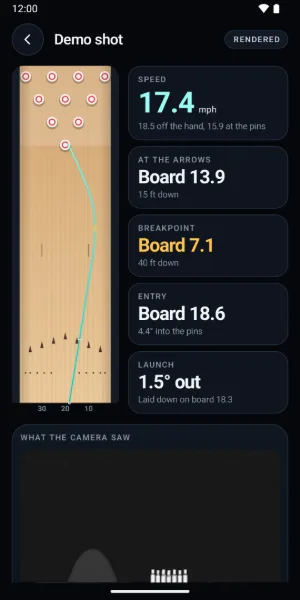
Not yet. BowlSight measures each shot’s speed, the board at the arrows, the breakpoint and the entry from a phone video. Until it measures revs too, this calculator does the job.
Or let BowlSight measure it
BowlSight is a bowling ball tracker for Android. With your phone on a tripod behind you, it measures every shot: the ball’s speed off your hand, on average and at the pins, the board at the arrows, the breakpoint and the entry angle. No sensor, no ads, and your videos stay on your phone.
Where these numbers come from
- The tape-and-clock method and its formula: USBC, “What’s your rev rate?”
- USBC’s average-bowler test delivery: USBC, equipment specifications.
- The stroker, tweener and cranker ranges: Wikipedia, “Bowling form”, and bowling.com, “Bowler types explained”.