Entry angle in bowling, and a calculator
Your entry angle is how steeply the ball comes into the pocket. Here’s what it is, why a few degrees matter, and a calculator that estimates yours from your breakpoint.
The calculator
What is entry angle?
Entry angle is the angle between the ball’s path and the boards as the ball reaches the pins. A ball going straight down the boards has an entry angle of 0°. A ball that hooks hard and late comes into the pocket at an angle, and drives through the pins instead of being pushed aside by them.
The pocket is between the head pin and the 3 pin for a right-hander (the 1 and 2 for a left-hander), around board 17½ counted from your own side. A study by the United States Bowling Congress (USBC) found that balls entering at board 17½ strike most often, and that between boards 17 and 18 you strike or leave a single pin most of the time.
How much is normal?
USBC’s pin carry research found that most bowlers get between 3° and 4° of entry angle into the pocket, and the sport’s best reach about 6°. A few degrees sounds small, but it changes how the ball moves through the pins: a flat ball deflects more and leaves more pins standing.
How the calculator works it out
After the breakpoint, the ball heads back toward the pocket. If it travelled in a straight line from the breakpoint to the pocket, its entry angle would be the angle of that line. But the ball keeps hooking, so its path bends and it comes into the pocket steeper than the line.
If the ball is still hooking evenly when it reaches the pins, it comes in at about twice the line’s slope. If it has stopped hooking and is rolling straight by then, it comes in close to the line itself. Your real entry angle is usually somewhere between the two, and that’s the range the calculator gives.
The line’s angle = arctan(boards across × 1.064 in ÷ feet down × 12)
A board is 41½ inches ÷ 39 boards, about 1.064 inches. The lane is 60 feet from the foul line to the head pin.
Getting more angle
The geometry says it plainly: a breakpoint farther from the pocket, or closer to the pins, gives a steeper line into the pocket. In practice that means playing deeper inside, or getting the ball to hold its line longer before it turns, with a stronger ball, more revs or less speed. A coach can help you find which suits your game.
Questions about entry angle
What is a good entry angle in bowling?
More angle generally helps the ball carry the pins. USBC’s pin carry research found that most bowlers enter the pocket at 3° to 4°, and the best bowlers reach about 6°.
Where is the pocket in bowling?
Between the head pin and the 3 pin for a right-hander, or the head pin and the 2 pin for a left-hander: around board 17½, counted from the side of your bowling hand. A USBC study found that balls entering at board 17½ strike most often.
How do I measure my entry angle?
You need the ball’s path near the pins: the board it’s on a few feet before the head pin and the board it reaches at the pins. From behind the bowler, that’s hard to see by eye. BowlSight works it out from a phone video, and this calculator gives a likely range from your breakpoint.
Why do I leave the 10 pin with a good-looking shot?
A ball that comes into the pocket flat, with little entry angle, tends to deflect off the pins, and for a right-hander that often leaves the 10 pin standing (the 7 pin for a left-hander). More entry angle helps the ball drive through.
Or let BowlSight measure it
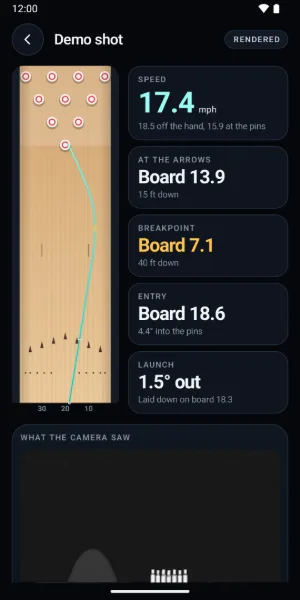
BowlSight is a bowling ball tracker for Android. With your phone on a tripod behind you, it measures every shot: the ball’s speed off your hand, on average and at the pins, the board at the arrows, the breakpoint and the entry angle. No sensor, no ads, and your videos stay on your phone.
Where these numbers come from
- Entry angles and the pocket board, from USBC’s pin carry and “I left what where?” studies: National Bowling Academy, “Aiming for the pocket: why didn’t I strike?”
- The lane’s width and length, 41½ inches in 39 boards and 60 feet to the head pin: USBC’s Equipment Specifications and Certifications Manual.