Bowling handicap calculator
Work out your league handicap from your average or your game scores, your league’s basis score and its percentage, the way the United States Bowling Congress (USBC) rules do it. Free, with a chart for every average at 90% of 220.
The calculator
How bowling handicap works
Handicap lets bowlers of different averages compete on even terms. Each bowler gets a number of pins added to every game, worked out from how far their average is below a basis score.
Handicap = percentage × (basis − your average)
Drop the fractions: from your average before you start, and from the handicap at the end.
- The basis (or scratch figure) is a score the league chooses. USBC suggests setting it higher than the league’s highest average.
- The percentage is set by the league too. USBC’s rules use 100% unless the league’s rules say otherwise; 80% and 90% are common choices. USBC’s own 2026 Senior Championships, for example, use 90% of 220.
- An average at or above the basis gets no handicap.
So with an average of 165 in a league that gives 90% of 220: 220 − 165 is 55, and 90% of 55 is 49.5, which becomes a handicap of 49 pins a game.
90% of 220 handicap chart
Every average from 100 to 219 at 90% of 220, the handicap USBC’s own 2026 Senior Championships use. At 220 or more, the handicap is 0.
| Average | …0 | …1 | …2 | …3 | …4 | …5 | …6 | …7 | …8 | …9 |
|---|---|---|---|---|---|---|---|---|---|---|
| 100s | 108 | 107 | 106 | 105 | 104 | 103 | 102 | 101 | 100 | 99 |
| 110s | 99 | 98 | 97 | 96 | 95 | 94 | 93 | 92 | 91 | 90 |
| 120s | 90 | 89 | 88 | 87 | 86 | 85 | 84 | 83 | 82 | 81 |
| 130s | 81 | 80 | 79 | 78 | 77 | 76 | 75 | 74 | 73 | 72 |
| 140s | 72 | 71 | 70 | 69 | 68 | 67 | 66 | 65 | 64 | 63 |
| 150s | 63 | 62 | 61 | 60 | 59 | 58 | 57 | 56 | 55 | 54 |
| 160s | 54 | 53 | 52 | 51 | 50 | 49 | 48 | 47 | 46 | 45 |
| 170s | 45 | 44 | 43 | 42 | 41 | 40 | 39 | 38 | 37 | 36 |
| 180s | 36 | 35 | 34 | 33 | 32 | 31 | 30 | 29 | 28 | 27 |
| 190s | 27 | 26 | 25 | 24 | 23 | 22 | 21 | 20 | 19 | 18 |
| 200s | 18 | 17 | 16 | 15 | 14 | 13 | 12 | 11 | 10 | 9 |
| 210s | 9 | 8 | 7 | 6 | 5 | 4 | 3 | 2 | 1 | 0 |
Handicap chart for other leagues
Handicaps for some common league settings, in pins a game.
| Average | 90% of 220 | 80% of 220 | 100% of 220 | 90% of 230 |
|---|---|---|---|---|
| 120 | 90 | 80 | 100 | 99 |
| 140 | 72 | 64 | 80 | 81 |
| 150 | 63 | 56 | 70 | 72 |
| 160 | 54 | 48 | 60 | 63 |
| 170 | 45 | 40 | 50 | 54 |
| 180 | 36 | 32 | 40 | 45 |
| 190 | 27 | 24 | 30 | 36 |
| 200 | 18 | 16 | 20 | 27 |
| 210 | 9 | 8 | 10 | 18 |
Questions about bowling handicap
How do you calculate a bowling handicap?
Take your league’s basis score, subtract your average, and multiply by the league’s percentage. Drop any fraction. With an average of 165 and a handicap of 90% of 220, that’s 90% of 55: 49 pins a game.
What does “90% of 220” mean?
It’s how a league describes its handicap: the basis score is 220, and each bowler gets 90% of the difference between 220 and their average. A 150 bowler gets 63 pins a game; a 200 bowler gets 18.
Is a bowling handicap rounded?
No, it’s cut down: USBC’s rules drop fractions rather than rounding them. A handicap of 49.5 becomes 49, and an average of 165.8 counts as 165.
What if my average is higher than the basis?
Then your handicap is 0. That’s one reason USBC suggests leagues set the basis above their highest average.
How do I work out my average?
Divide your total pins by the games you’ve bowled, and drop the fraction. Our bowling average calculator does it from your scores.
Can I work out my handicap from my scores?
Yes. Choose “My game scores” in the calculator and enter your games: it adds them up, divides by the number of games, drops the fraction, and works out the handicap from that average. Three games of 182, 204 and 167 make an average of 184, which at 90% of 220 gets 32 pins a game.
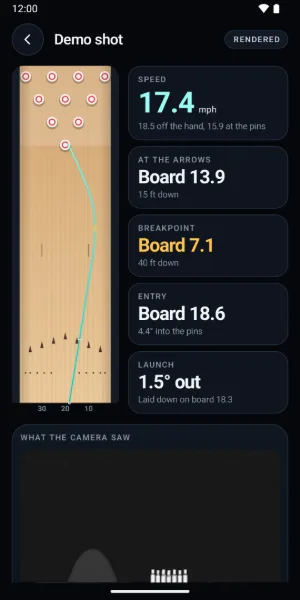
Or let BowlSight measure it
BowlSight is a bowling ball tracker for Android. With your phone on a tripod behind you, it measures every shot: the ball’s speed off your hand, on average and at the pins, the board at the arrows, the breakpoint and the entry angle. No sensor, no ads, and your videos stay on your phone.
Where these rules come from
- The handicap rule, its 100% default and dropped fractions: USBC Playing Rules.
- Setting the basis above the highest average: USBC League Operations Handbook.
- 90% of 220 at the 2026 Senior Championships: USBC Senior Championships rules.